When a profile moving head creates a rectangular frame, why can one edge appear less sharp than the other three?
The answer lies partly in the design of its framing system. Whether you call it a profile moving light or an LED profile moving light, the quality of the framing mechanism plays an important role in achieving clean, precise edges. Let’s take a closer look at how the framing shutters work and why their construction can affect performance.
How Does a Four-Blade Framing System Work?
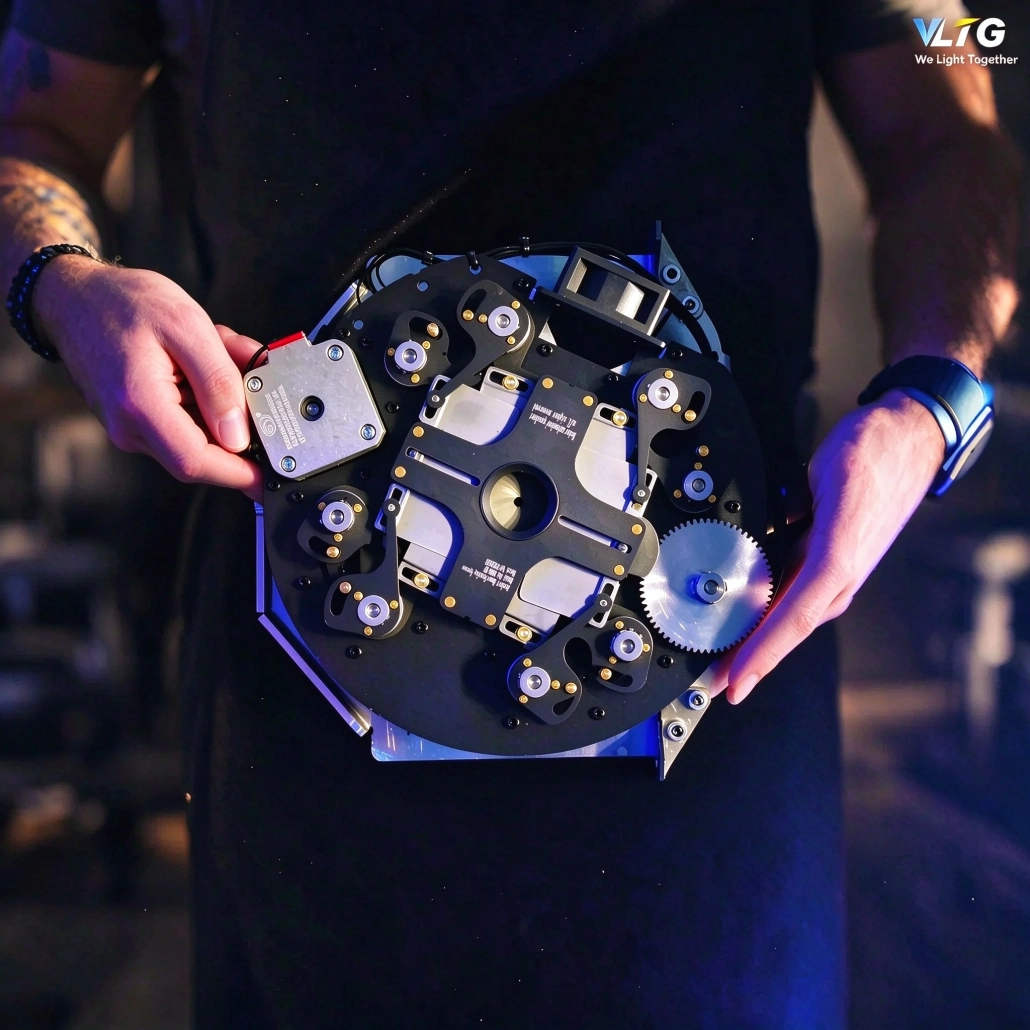
Inside a profile moving head, the framing system consists of four shutters positioned at the top, bottom, left, and right of the light beam.
Each shutter is driven by a motor and moves in and out of the beam, blocking part of the light to create different shapes and control the illuminated area.
When all four shutters move inward to create a rectangular frame, their tips approach one another at the four corners. This is where the mechanical design of the framing system becomes particularly important.
Why Is It Difficult to Keep All Four Edges Sharp?
So why can even the most expensive profile moving heads struggle to achieve equally sharp edges on all four sides? The answer lies in the framing system itself.
1. The Shutter Tips Can Interfere with Each Other
When all four shutters move toward the center, their tips approach one another. Because each shutter has a certain thickness, the tips can physically obstruct part of the light path.
This interference can affect how cleanly the light is blocked, particularly around the corners, and may contribute to uneven edges or unwanted light leakage.
2. The Shutters Are Arranged on Different Planes
The four shutters are arranged in layers inside the framing assembly, so they do not all sit on exactly the same plane.
Their tips therefore cannot always align perfectly as they move inward. Depending on the shutter geometry and mechanical tolerances, this can make it more difficult to achieve consistent edge definition on all four sides.
The result may be light leakage, ragged edges, or a softer, feathered appearance along part of the frame.
3. Component Precision and Material Quality Matter
If the framing components have poor manufacturing precision or inconsistent dimensions, interference between the shutters can become more noticeable.
Material quality also matters. Components need to maintain their shape and mechanical properties under the fixture’s operating conditions.
Over extended use, heat can cause some materials to expand or deform. If this affects the alignment or movement of the framing components, edge definition may deteriorate further.
This is why framing performance depends not only on the shutter mechanism itself, but also on manufacturing accuracy, material selection, and thermal stability.
What Makes a Profile Moving Head Worth the Investment?
When choosing an LED moving head light for professional applications, light output and feature lists are only part of the equation. Framing precision, mechanical reliability, thermal stability, and overall fixture design all influence performance.
For rental companies, operating costs are another important consideration. Lighter, more compact fixtures can help reduce air and road freight costs, particularly for international tours that require frequent transportation between countries and venues.
When a fixture combines the required stage performance with practical advantages in handling and logistics, it can offer greater value over its service life and contribute to a stronger return on investment (ROI).
How Does VLTG Improve Framing Performance?
As a professional stage lighting manufacturer, VLTG Lighting focuses on the engineering details that influence the performance and reliability of our lighting fixtures.
We use high-precision components and heat-resistant materials in our framing systems to achieve sharper framing edges and help maintain consistent performance over time.
For professional lighting applications, these details matter. Cleaner framing helps lighting designers control where light falls, while stable mechanical performance supports reliable operation during repeated use.
VLTG Profile Moving Heads: From 450W to 1600W
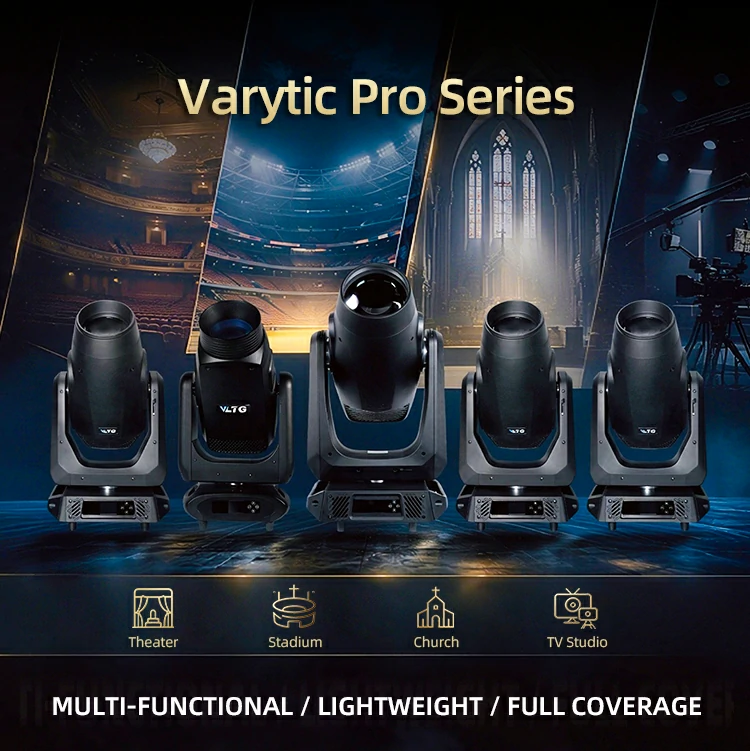
VLTG Stage Lighting develops and manufactures profile moving heads ranging from 450W to 1600W, serving different performance requirements and production needs.
Lightweight design is a key consideration across our profile moving head range. We focus on compact structures and weight optimization while maintaining the performance required for professional lighting applications.
For rental companies and touring production teams, this design approach can help reduce transportation demands, simplify equipment handling, and make logistics more manageable. These practical advantages can be especially valuable for businesses that regularly transport equipment across borders.
Our range reflects VLTG’s focus on product development, mechanical engineering, and manufacturing, with attention to the details that matter in real-world applications.
Explore the VLTG LED600 Profile Moving Head or browse our full range of profile moving heads to learn more about our products.

